
Education carries an extraordinary responsibility—not merely to transmit knowledge but to nurture the complete human being. In a rapidly changing world, educators must prepare learners not only for academic success but also for purposeful, balanced, and impactful lives.
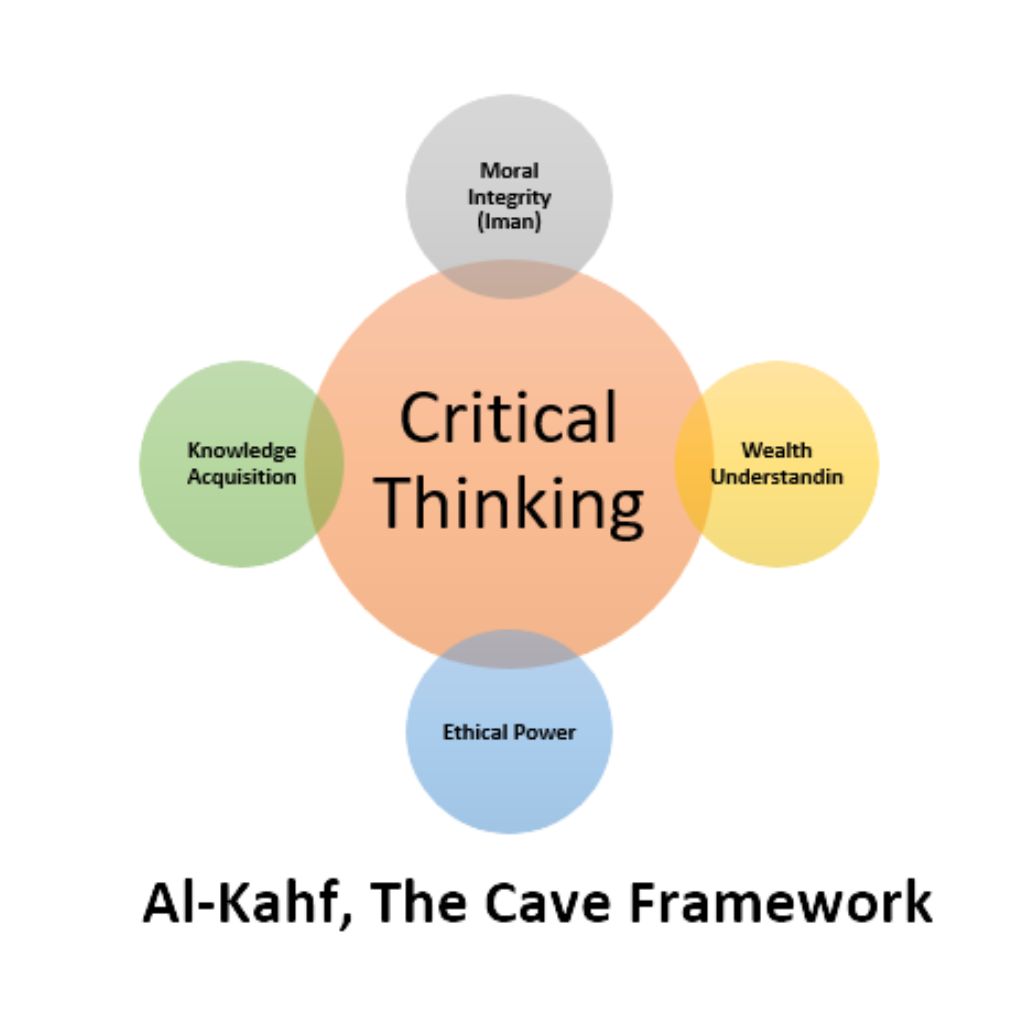
Drawing inspiration from the timeless wisdom of Surah Al-Kahf (The Cave) in the Qur’an, I present “Al-Kahf, The Cave Framework,” a model I have developed to guide holistic human development in education. It cultivates excellence across four essential domains: Moral Integrity (Iman), Wealth Understanding, Knowledge Acquisition, and Ethical Power. This aligns with the principles of a Holistic Education Model.
This framework aligns with the principles of the Holistic Education Model, emphasizing the importance of integrating academic and personal growth for well-rounded development.
In essence, the Holistic Education Model provides a comprehensive approach that transcends traditional educational confines, ensuring that every individual is nurtured to their fullest potential.
Although rooted in Islamic heritage, its principles transcend religious boundaries, offering a universal blueprint for schools and educators striving to develop capable, reflective, and conscientious individuals.
The Source of the Framework: Lessons from Surah Al-Kahf
Surah Al-Kahf is revered for its compelling narratives, each of which embodies universal virtues and timeless lessons. Together, these stories illustrate the ideal balance between faith, material stewardship, intellectual pursuit, and ethical leadership:
- The People of the Cave demonstrate steadfast faith and resilience in the face of adversity.
- The Man with Two Gardens teaches humility, gratitude, and responsible use of wealth.
- The Journey of Musa and Khidr underscores the importance of humility and patience as the foundations of true knowledge.
- The Story of Dhu al-Qarnayn models leadership guided by justice, compassion, and accountability.
These four accounts collectively offer an integrated vision for human development, uniting spiritual, moral, intellectual, and social dimensions of education.
I. Moral Development: Cultivating Authentic Character and Values
At the heart of the framework lies moral development—the formation of character grounded in integrity, empathy, and resilience.
These elements are foundational in the Holistic Education Model, which seeks to balance knowledge with ethical and moral development.
For Muslim institutions, this includes nurturing Iman (faith) as a source of ethical guidance and inner strength. Yet, the importance of moral education extends across all traditions. Every school seeks to cultivate individuals who act with compassion, uphold their principles, and make ethical decisions even in challenging circumstances.
Embedding critical thinking within moral education enables students to reflect on societal values, thoughtfully question ethical dilemmas, and develop into principled citizens. Such an approach fosters not mere rule-following but a genuine internalization of virtues necessary for both personal fulfillment and social harmony.
This principle is key in the implementation of a Holistic Education Model, fostering character that is not only knowledgeable but also compassionate.
The Holistic Education Model encourages students to engage with their community, enhancing both their learning experience and moral compass.
II. Wealth: Preparing Students for Responsible Economic Stewardship
In the context of the Holistic Education Model, the lessons learned from these narratives are critical for economic literacy and ethical stewardship.
The story of the Man with Two Gardens reminds humanity that wealth is neither an end in itself nor a private possession—it is a trust and a means to sustain life and support the community.
Equipping students with these values is essential in the Holistic Education Model, promoting an understanding of wealth’s role in society.
Embracing the Holistic Education Model
Modern education must therefore make financial literacy a central element, equipping students with practical money management skills, awareness of economic systems, and an understanding of the social and environmental consequences of consumption.
Alongside competence, gratitude, and social responsibility, these values must be cultivated so that students view wealth as a blessing to be used ethically and sustainably. Whether in Islamic or secular settings, this approach strikes a balance between ambition and humility, fostering equitable prosperity.
Adopting the Holistic Education Model can facilitate a more profound commitment to learning, emphasizing continuous growth and adaptability.
III. Knowledge: Fostering Lifelong Curiosity and Humility
The narrative of Musa and Khidr teaches that true knowledge requires humility and patience. Learning is a lifelong journey, and understanding often unfolds in unexpected ways.
In this way, the Holistic Education Model nurtures leaders who are not only knowledgeable but also socially and ethically responsible.
This holistic approach is what the Holistic Education Model embodies, preparing students for leadership roles in a complex world.
Education systems should therefore nurture curiosity, critical inquiry, and appreciation for diverse perspectives. Encouraging students to explore ideas deeply—not merely memorize—empowers them to think independently, solve complex problems, and remain open to continual learning.
Thus, the Holistic Education Model places critical thinking at the core of its methodology, allowing students to become insightful and engaged learners.
This integration is crucial for the Holistic Education Model, enabling students to approach learning with a critical and open mindset.
Such intellectual humility and curiosity are vital for innovation and adaptability in every field.
Through these actions, the Holistic Education Model strives for a transformative impact on educational practices globally.
IV. Power: Developing Ethical Leadership and Social Responsibility
Dhu al-Qarnayn’s story offers a timeless model of leadership rooted in justice, accountability, and compassion. Schools play a crucial role in preparing future leaders who strike a balance between confidence and empathy, and authority and service.
Leadership education should emphasize collaboration, ethical reasoning, and civic responsibility. When students learn to exercise influence with fairness and empathy, they are equipped to make meaningful contributions in an interconnected world.
The Unifying Thread: Critical Thinking Across All Domains
Central to the Al-Kahf Framework is critical thinking—the disciplined ability to question, analyze, synthesize, and apply knowledge. The Qur’an itself encourages reflection and reasoning as pathways to understanding.
The Holistic Education Model serves as a reminder of the universal values that education should uphold.
Whether applied to morality, wealth, knowledge, or leadership, critical thinking empowers learners to avoid blind conformity, recognize bias, and respond creatively to change. Integrating this mindset into every subject transforms education from passive instruction into active engagement, preparing individuals who can think critically, adapt flexibly, and act with wisdom.
The principles of the Holistic Education Model are essential for cultivating a new generation of ethical leaders.
Ultimately, the Holistic Education Model provides a framework for achieving not just knowledge but wisdom in the educational journey.
The Holistic Education Model is a call to action for educators everywhere to foster meaningful and lasting change.
Practical Implementation: Toward a New Educational Vision
Applying the Al-Kahf Framework requires systemic transformation grounded in reflective and inclusive pedagogy:
- Curricular Integration: Design interdisciplinary programs embedding moral reasoning, financial literacy, inquiry skills, and leadership principles.
- Pedagogical Practices: Utilize inquiry-based learning, reflective discussions, experiential projects, and community engagement to foster critical thinking.
- Assessment and Feedback: Evaluate reasoning, ethical judgment, collaboration, and academic achievement.
- School Culture: Create environments that value diversity, foster dialogue, and promote moral and intellectual growth.
Faith-based or secular, every institution can adapt the framework to its context while advancing universally valued human capacities.
Conclusion
Al-Kahf, The Cave Framework, renews the purpose of education by uniting timeless principles with contemporary needs. It calls on educators to raise individuals who are morally grounded, financially responsible, intellectually curious, and ethically empowered.
At its core, it positions critical thinking as the heartbeat of learning—enabling students not only to achieve personal success but also to contribute meaningfully to the well-being of humanity.
Its strength lies in its universality, inviting all educational communities to reflect, adapt, and aspire toward a future where learning leads to wisdom, justice, and sustainable progress.
References
- Lickona, T. (1996). Eleven Principles of Effective Character Education. Journal of Moral Education, 25(1), 93–100.
- Lusardi, A., & Mitchell, O. S. (2014). The Economic Importance of Financial Literacy: Theory and Evidence. Journal of Economic Literature, 52(1), 5–44.
- King, P. M., & Kitchener, K. S. (2004). Reflective Judgment: Theory and Research on the Development of Epistemic Assumptions. Educational Psychologist, 39(1), 5–18.
- Ciulla, J. B. (2004). Ethics and Leadership Effectiveness. In Ethics, the Heart of Leadership (2nd ed., pp. 67–81). Praeger.
- The Holy Qur’an, Surah Al-Kahf, 18:9–101.
- Facione, P. A. (2011). Critical Thinking: What It Is and Why It Counts. Insight Assessment.


0 Comments